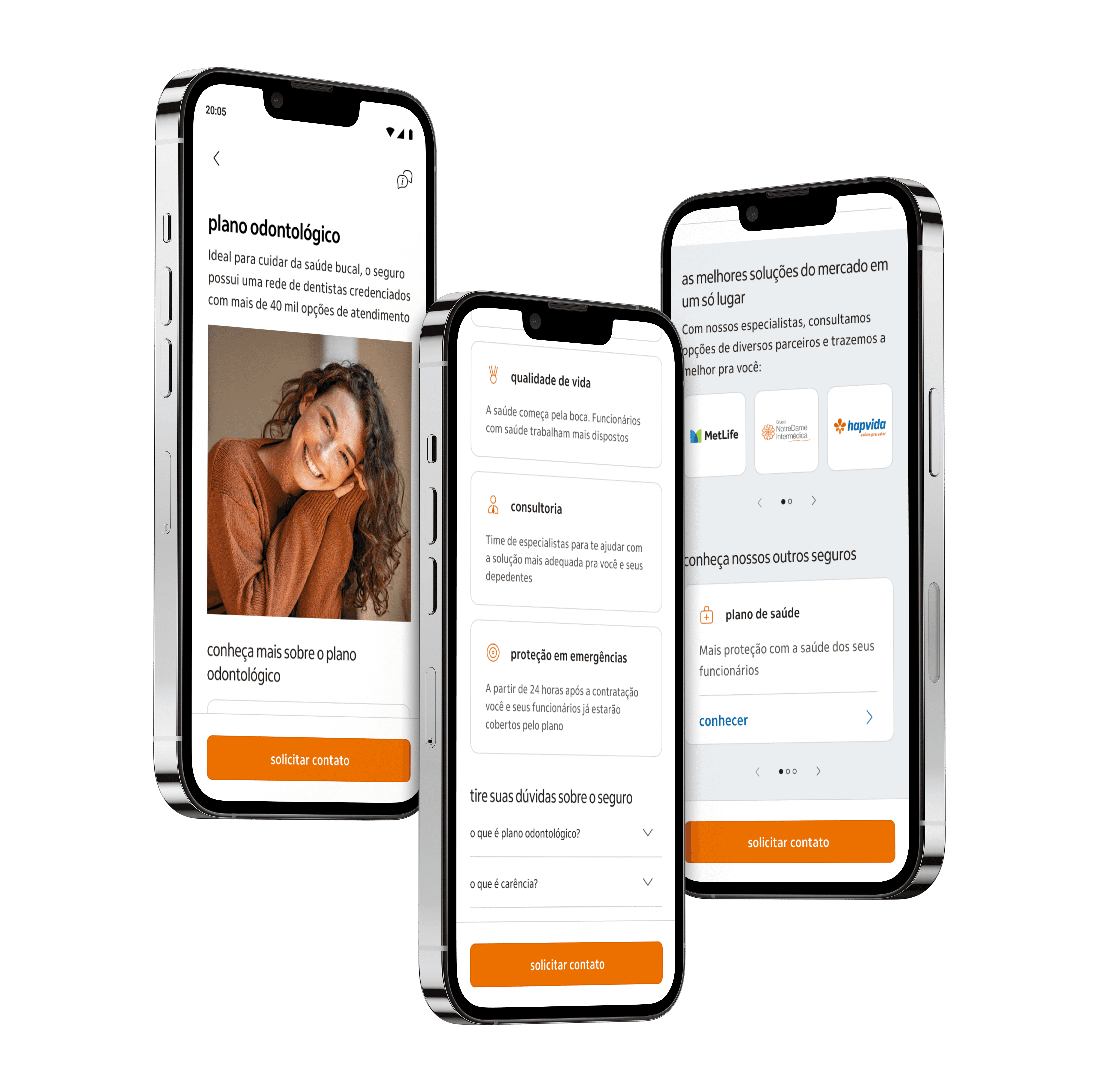
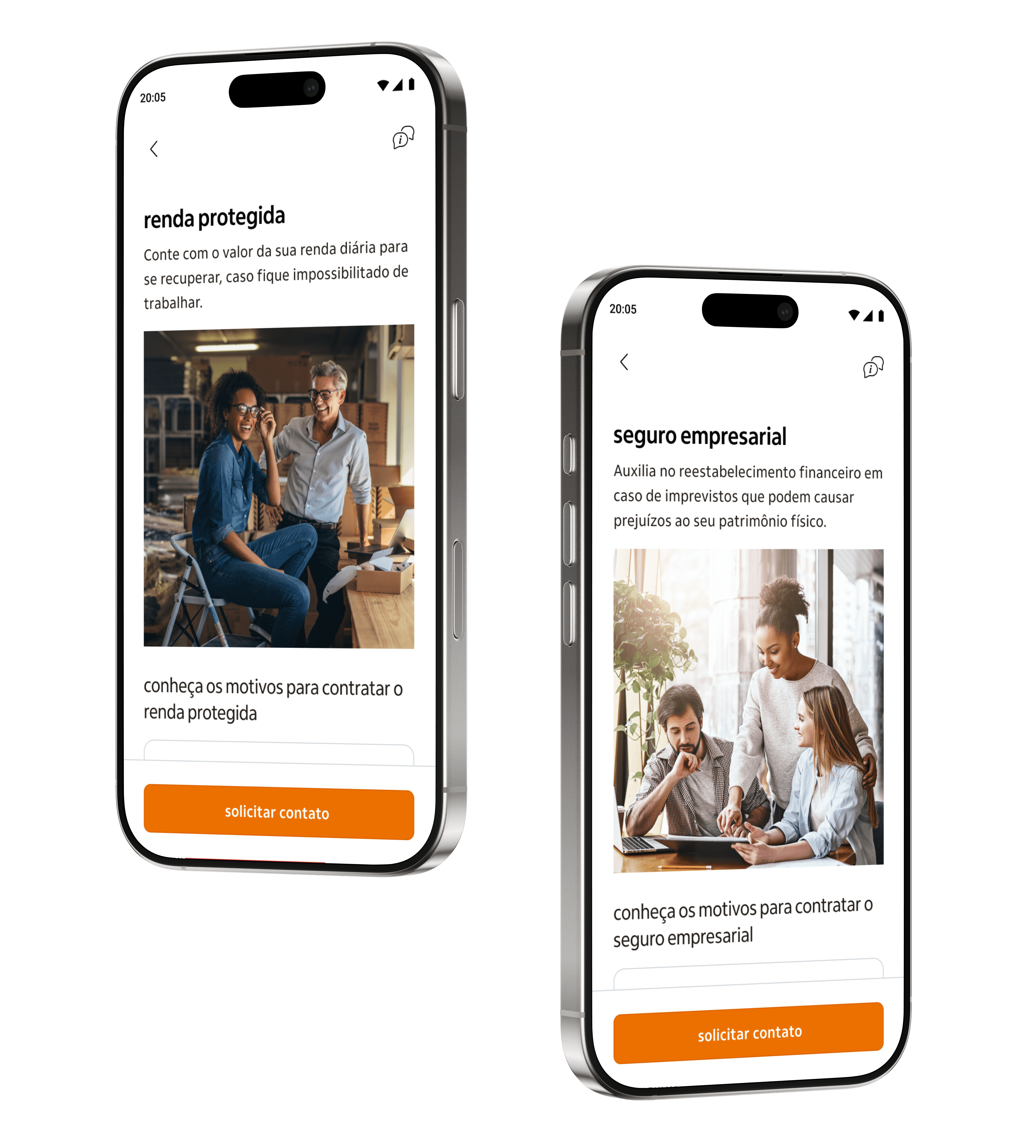
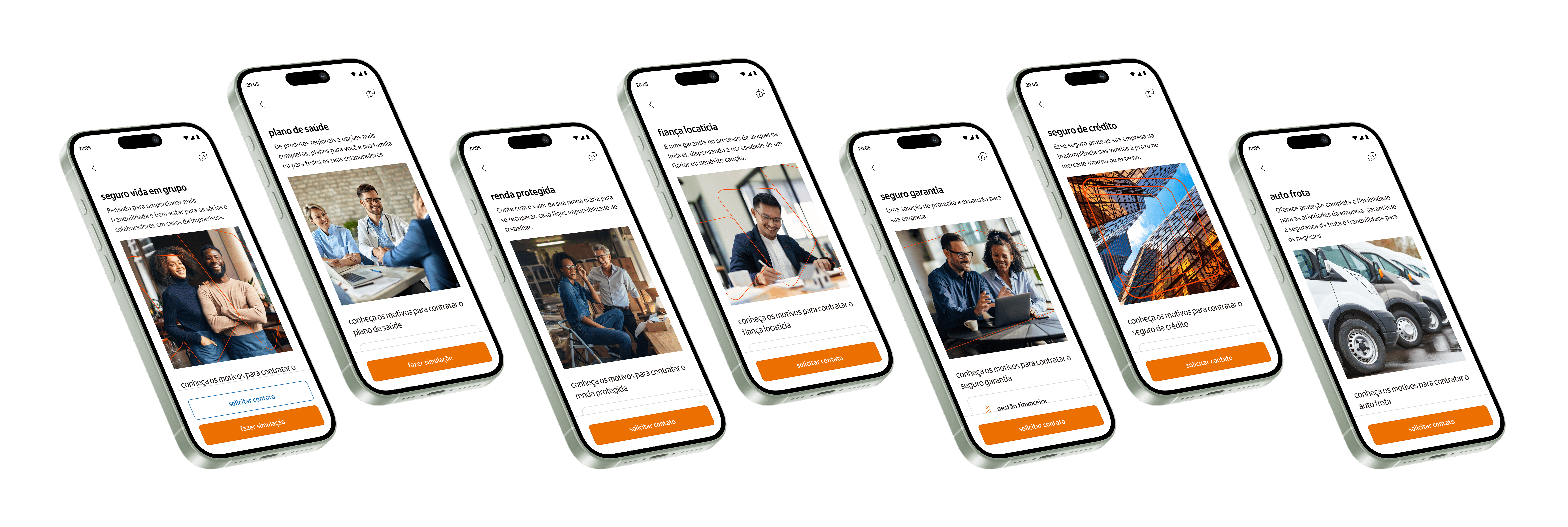
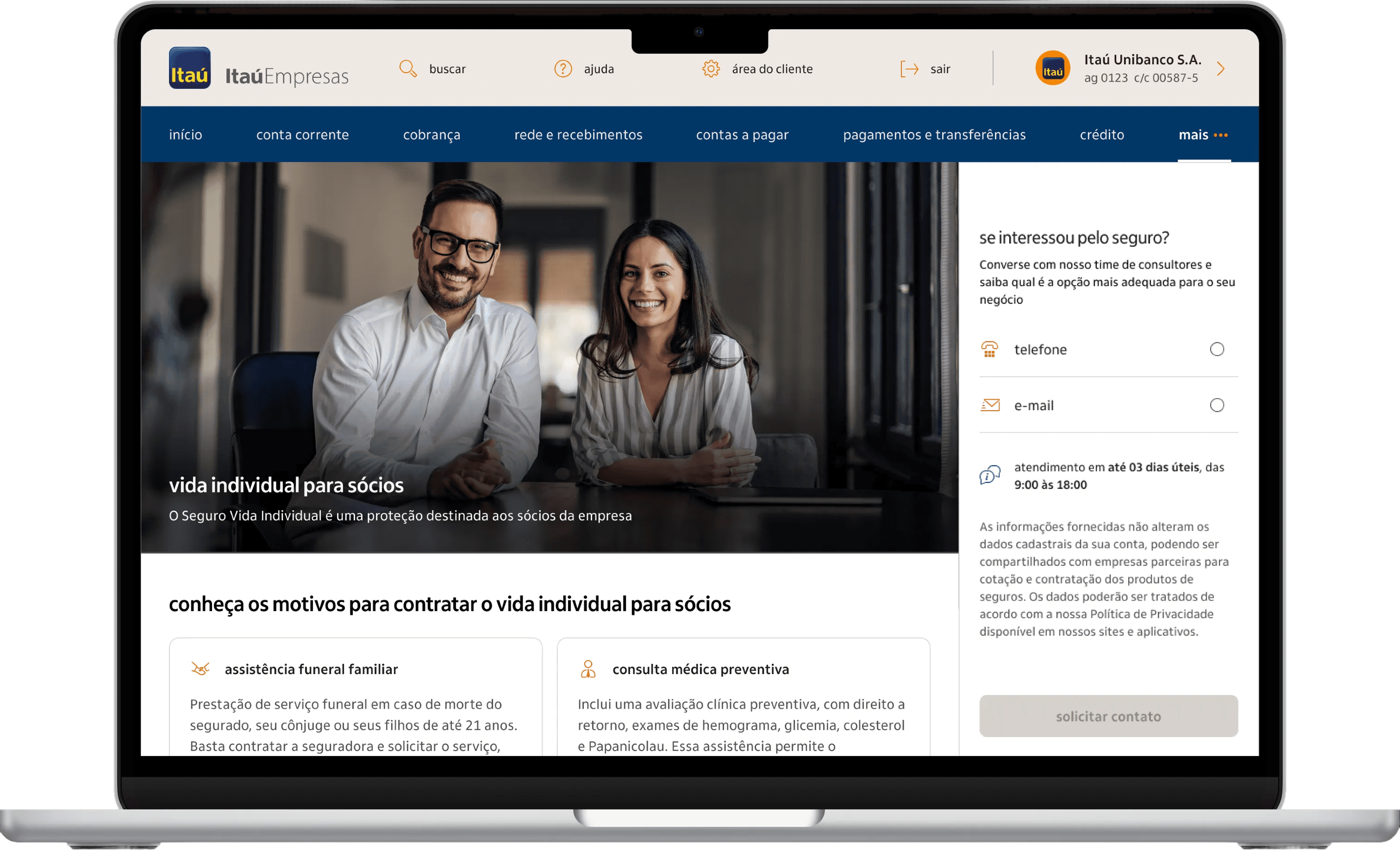
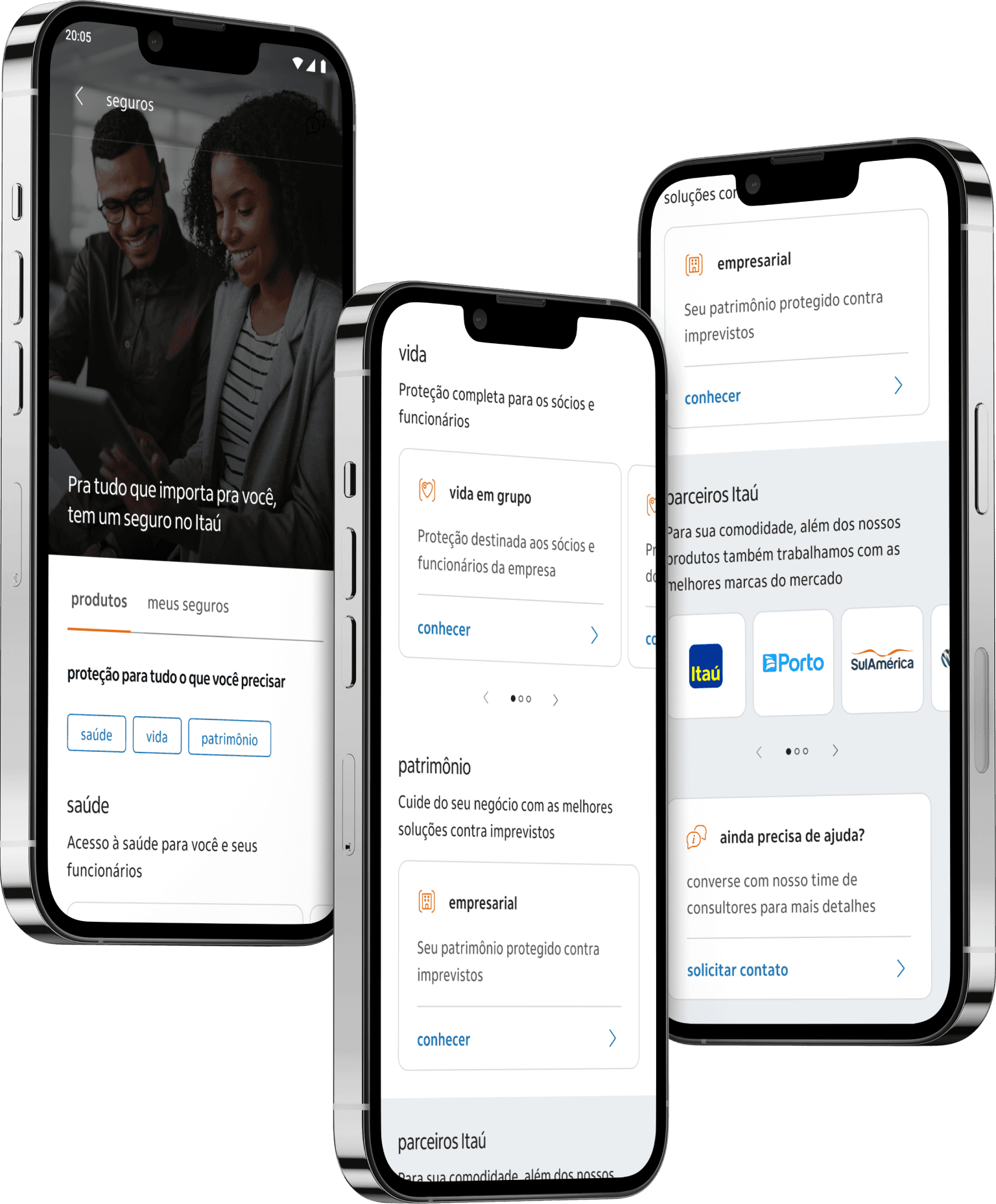
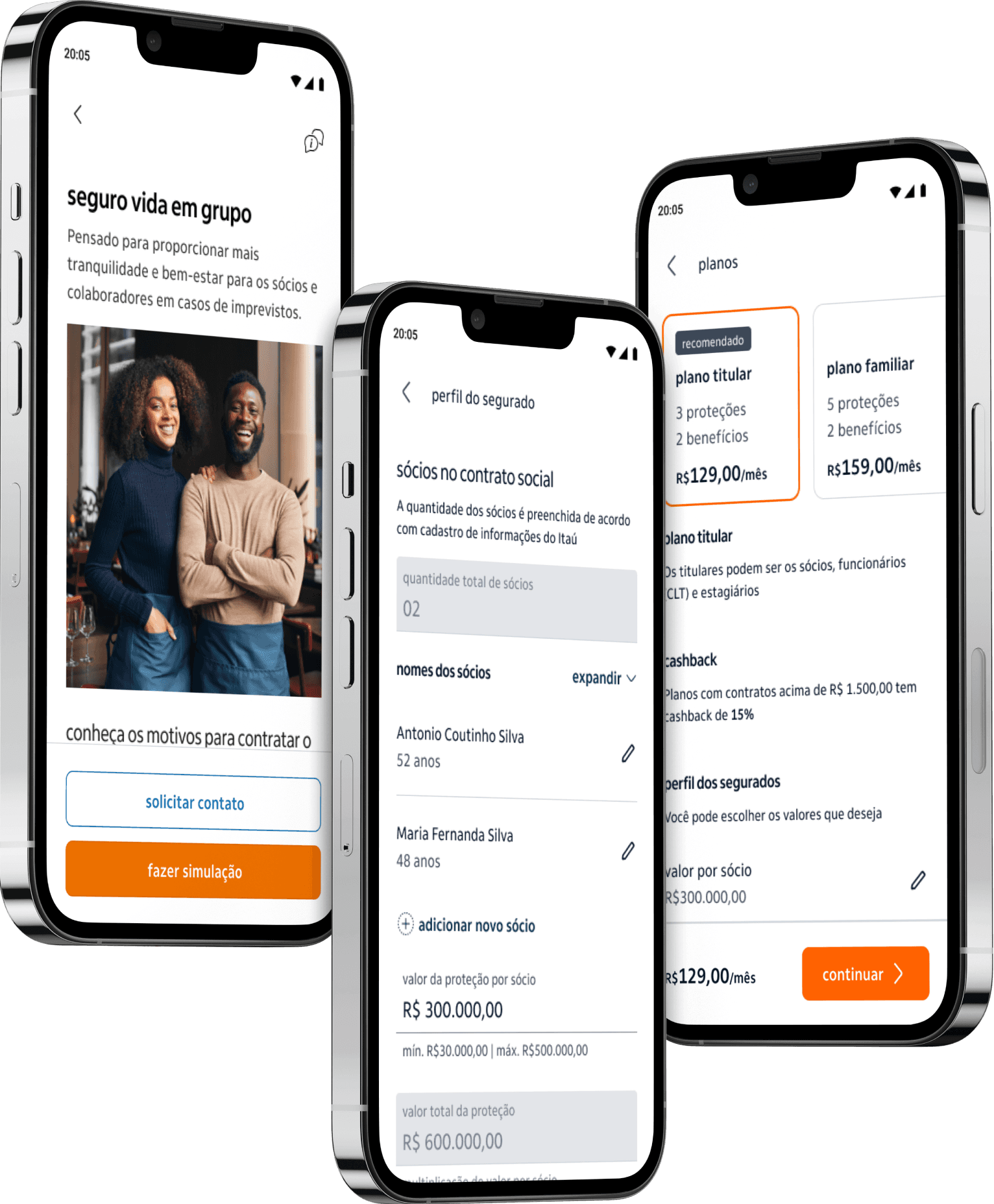
Creation and development of 10 new products, with versions for mobile and desktop, totaling 20 deliveries. The solutions were based on clarity, conversion, and scalability, using Micro-Frontends (MFE's).
Company: Itaú
Segment: Itaú Companies Insurance
Environment: Logged in area
Reach: ≈ 1.7 million customers
Platform: Mobile and Desktop
Year: 2022 - 2023
Research: Quantitative, qualitative, and in-depth interviews
Visual: Creation and design of the journey using Design System
Navigable prototyping: Mobile and Desktop
Testing: Usability
Technical Specification: Accessibility
Analysis of results: Metrics
There was a lack of better communication of the PJ Insurance products in digital channels, which resulted in low awareness among clients. Many only discovered options for other insurance when they were presented or offered by their managers.
During the process of evaluating the existing journeys, we identified opportunities for evolution, redesigned and created new landing pages for the PJ Insurance area.
To ensure scalability and consistency, we chose to develop the new journeys with Micro-Frontends (MFE). This approach, together with the technology team, enabled visual and technical standardization, as well as significant gains in optimization and agility.
The project went through stages of research, interviews, analysis, Design Critique, and technical reviews with the Writing and Accessibility team, ensuring a consistent and accessible construction.
The final prototypes included all variations. First, we created a journey and, once validated, it served as a reference basis for the others, thus ensuring a standard throughout the experience.
Six individual tests were conducted with Itaú Empresas account holders, covering different ages, genders, and business segments. The main objective was to understand perceptions of the new design and navigation of the new landing pages.
During the tests, in the first version presented, we identified that some people had difficulties understanding the use of the carousel that showcased the product benefits. However, this difficulty was mostly due to the component itself, which did not convey the upcoming cards intuitively.
These insights were essential for adjustments to the journey.
An important highlight was the “request contact” stage (lead generation), in which users showed a preference for immediate assistance, primarily via WhatsApp. Additionally, the preference for a humanized service — with an agent or manager — was significant, as it increased trust and security in the contracting process.
The 20 journeys were implemented simultaneously. The use of MFE's was fundamental in these constructions, and the development time became much faster and more practical.
Over time, some products evolved into complete digital contracting journeys, while others remained only as qualified lead capture, which will require long-term adjustments.
Analyzing 06 products offered, we increased by 145% the access to the new LP’s in the period of a year, promoting more accurate and complete information.
The digital availability of these insurance products represents a significant advance, allowing customers to explore options with more autonomy in the area of Business Insurance — without relying exclusively on the assistance of a consultant or a manager.
As this is a development in Micro-Frontend, it was important to think about scalability and simplicity, making the information easy to understand, without the need to consult a manager; that is, everything on one screen, in an objective and direct way.
This was the first project I developed using MFE's. The experience was valuable, as it served as a foundation for other products and this facilitated the understanding regarding the usage, both from the experience and the technology.
Another important lesson was to understand and analyze user behavior during usability tests, as this brought us more clarity and assertiveness.